
Virtual Tours for Education: Field Trips Without Walls
How virtual tours are transforming education — geography, history, science and biology lessons inside explorable 360 environments, virtual field trips, campus open days and genuinely accessible learning.
Key Takeaways
- Virtual field trips remove the cost, logistics and risk of physical trips.
- Geography, history, science and biology all have strong 360 use cases.
- AI-generated worlds like 360Worlds make impossible places explorable - ancient Rome, inside a cell, other planets.
- Campus tours and virtual open days reach international and remote families.
- Tours make trips accessible to students with mobility, sensory or medical needs.
Education has always run on a cruel constraint: the most powerful way to learn about a place is to go there, and going there is expensive, slow, risky and — for many students — impossible. Virtual tours dissolve that constraint. This article covers how 360 experiences are changing what happens in classrooms, and how schools and universities market themselves.
(For the fundamentals of the medium, see the ultimate guide to virtual tours.)
The virtual field trip
A traditional field trip involves coaches, consent forms, risk assessments, per-head costs and a day of logistics for a few hours on site. A virtual field trip involves a link.
That is not to say it replaces the real thing — nothing replaces standing on a windswept coast measuring longshore drift. But the realistic alternative to most virtual trips was never a physical trip; it was a PowerPoint. And against a slideshow, an explorable 360 environment where students choose where to look is a different order of engagement.
The world's great institutions have already done much of the work: world-class museums, national parks and even the ISS publish free tours that teachers can build lessons around today.
Subject by subject
Geography
The natural fit. Landform case studies (glaciated valleys, meanders, coastal erosion) explored in 360 rather than described; urban land-use transects walked virtually; comparative studies of settlements a class could never visit. Street-level 360 imagery turns "imagine a favela" into "look around one, and tell me what you notice".
History
History's problem is that its subject matter no longer exists — you can visit the Colosseum, but not the Colosseum full of Romans. Captured tours handle the first: castles, battlefields, museums and heritage sites in 360. Generated environments handle the second, and that changes the subject profoundly (more below).
Science and biology
Scale is science teaching's enemy: the interesting things are too big (planetary surfaces), too small (cells), too dangerous (volcano interiors) or too remote (deep ocean). 360 environments make scale explorable — walk NASA's Mars imagery, float through a coral reef, stand inside a modelled human heart while the teacher narrates the chambers.
Space
The richest free content library in education: NASA and ESA's tours of the International Space Station and stitched Mars rover panoramas let a class stand on another planet during fourth period. It reliably produces the reaction every teacher is chasing: whoa.
AI-generated worlds: teaching the impossible
Everything above uses cameras, which means it is limited to places that exist and can be photographed. The frontier is AI-generated explorable environments — and education is their killer application.
360Worlds, part of the same ReHub family as 360tours.studio, generates immersive 360 worlds from prompts. For teaching, that removes the last constraint:
- Ancient Rome on market day — not ruins, the living city, for a history class that walks its streets.
- Inside a volcano, safely — magma chambers as a geography lesson.
- The Cretaceous — ecosystems that vanished 66 million years before cameras.
- Inside a cell — biology at a scale no lens reaches.
- Story settings — literature classes exploring the moors of Wuthering Heights or a Dickensian street.
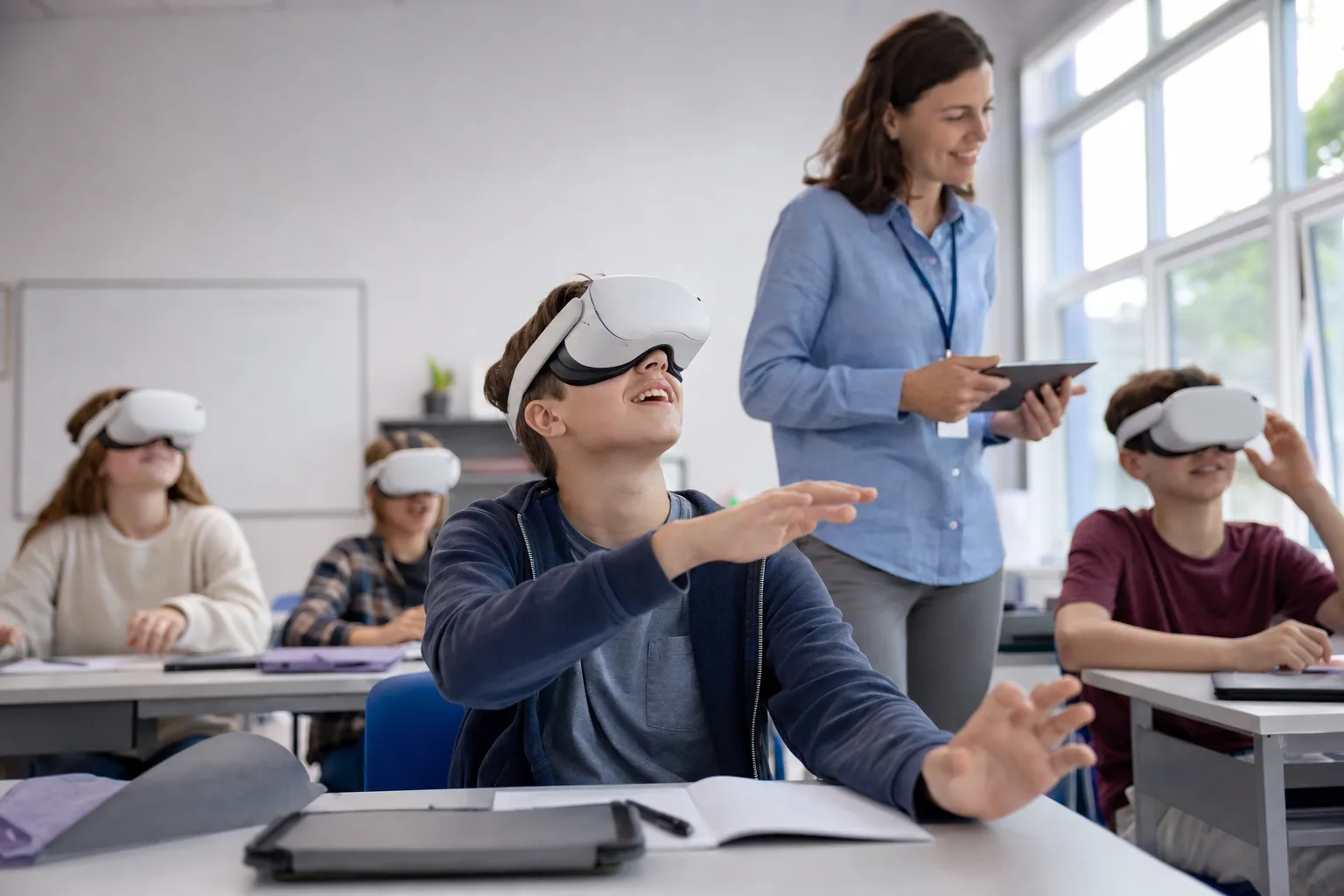
A generated world plus a teacher's narration is a lesson format that simply did not exist five years ago. Paired with affordable headsets, it turns VR's presence effect into a learning tool: students do not read about places, they remember being there.
Accessibility: the quiet superpower
The least-discussed benefit may be the most important. Physical field trips exclude: students with mobility needs, medical conditions, sensory sensitivities, anxiety, or families who cannot afford the coach fee. Virtual trips include everyone — the same environment, explored from the same classroom, at each student's own pace.
Tours also serve students who miss school for illness or caring responsibilities, and — with AI narration and translation — learners working in a second language. Inclusion here is not a compliance checkbox; it is the format working as designed.
The other half: marketing the school itself
Education institutions are also venues, and everything in the business case for virtual tours applies to them directly.
Virtual open days
A physical open day reaches families who are free that Saturday and live within driving distance. A 360 campus tour reaches everyone else — permanently. Head-teacher welcome videos embedded in reception, hotspots on the science labs, sports hall and library, and narration in the languages your intake actually speaks.
International recruitment
For universities, the highest-stakes use case: international students commit years and significant fees to institutions most will never visit before accepting. A thorough 360 tour of accommodation, facilities and the surrounding city is the closest thing to a visit — and universities without one are asking applicants to buy blind.
Practical logistics
Tours also quietly serve operations: orientation for new students, familiarisation for supply staff, venue marketing for schools that hire out halls and sports facilities (a real revenue line), and reassurance for parents choosing boarding schools from overseas.
Getting started
For using tours in lessons: start free. The best tours online plus 360Worlds cover an enormous curriculum surface with zero budget. Tours run on the browsers and whiteboards you already own.
For publishing a campus tour: a 360 camera, a staff member with one free afternoon, and 360tours.studio — the full process is in How to create a virtual tour. Add a floor plan for wayfinding, an AI guide for narration, and publish one link that works on every family's device — including VR headsets on open-day stands. See pricing or explore the demo to judge the format yourself.
The classroom has walls. The curriculum never did — and now the lesson doesn't have to either.
Frequently Asked Questions

The 360tours.studio Team
Virtual Tour Experts
We build interactive 360 virtual tour software for estate agents and property marketers.
Related Articles
Why Every Business Should Have a Virtual Tour
Hotels, schools, estate agents, healthcare, manufacturing, retail and offices — here is the industry-by-industry case for why every business with a physical space should publish a virtual tour.
360Tours Studio vs Matterport: Which Virtual Tour Platform Is Best?
Comparing 360Tours Studio and Matterport: digital twins vs interactive 360 experiences, image quality, AI features, branding, capture speed and which platform fits marketing, education, tourism and property.
The Ultimate Guide to Virtual Tours (2026)
Everything you need to know about virtual tours: what they are, how they work, the technology behind them, the industries using them, and where AI and VR are taking immersive experiences next.