
How AI Is Changing Virtual Tours
AI narration, instant translation, image enhancement, virtual staging and fully generated 360 environments — how artificial intelligence is transforming every stage of the virtual tour pipeline.
Key Takeaways
- AI now handles image enhancement automatically - HDR, noise, sharpening, straightening.
- AI voice narration gives every tour a 24/7 guide, in any language.
- Virtual staging furnishes empty rooms digitally, with an in-tour toggle.
- Conversational AI guides answer viewer questions inside the tour.
- Generative AI creates explorable environments no camera could capture - 360Worlds is the case study.
Artificial intelligence is not "coming to" virtual tours — it is already embedded in every stage, from the moment a panorama is captured to the way a viewer asks questions inside the finished experience. This article maps what AI does for tours today, what is emerging, and what it means if you publish tours for a living.
For the broader context on tours themselves, see the ultimate guide to virtual tours.
AI image enhancement: invisible but everywhere
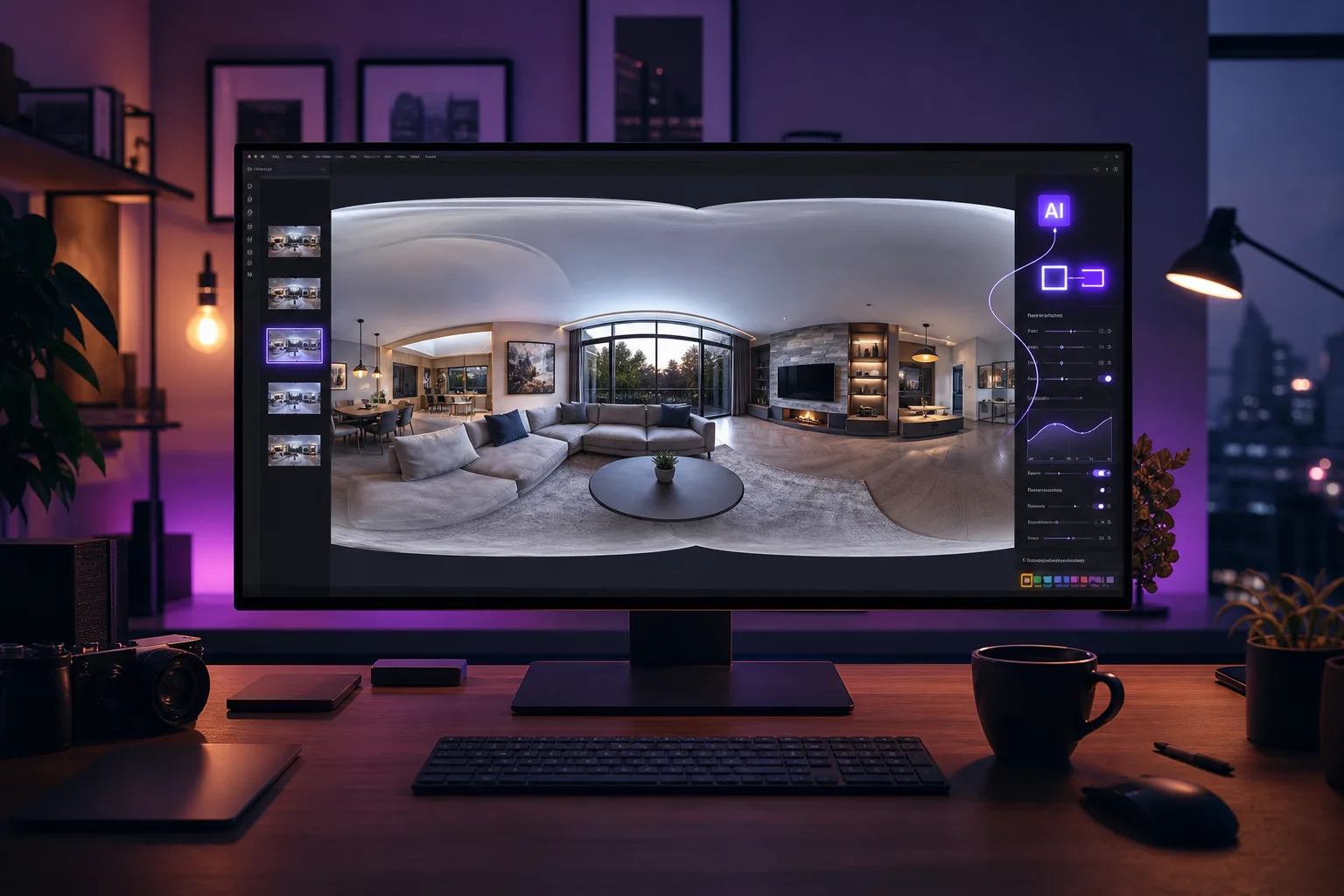
The least glamorous application is the most universally used. When panoramas are uploaded to a modern tour platform, AI models handle:
- Exposure and HDR blending — balancing bright windows against dark interiors, the classic 360 interior problem.
- Noise reduction and sharpening — recovering detail from small camera sensors shooting in dim rooms.
- Straightening and levelling — correcting horizon tilt so vertical lines stay vertical.
- Object removal — erasing the tripod from the bottom of the sphere, and increasingly de-cluttering rooms entirely.
The practical effect: capture quality that needed a professional editor five years ago now happens automatically between upload and publish. This is a big part of why creating a tour has collapsed from a specialist job to a 40-minute task.
The same model families power the wider ReHub Studio ecosystem this platform belongs to — AI photo decluttering, HDR enhancement and day-to-dusk conversion — all of which feed better source imagery into tours.
AI narration: every tour gets a guide
Text-to-speech crossed the "actually sounds human" threshold, and it changed what a tour can be. Instead of silent rooms, a tour can now walk its viewer through the space — pointing out the south-facing garden, the re-wired electrics, the walk to the station — exactly like a human guide, except available 24/7 to unlimited simultaneous viewers.
In 360tours.studio this is the AI Agent Guide: write or auto-generate a script per scene, pick a voice, publish. For estate agents it means every listing carries its best sales pitch on every viewing, including the ones that happen at midnight.
AI translation: one tour, every language
The narration layer being AI-generated means it is also regenerable — in Spanish, Mandarin, Arabic or Polish, from the same script, in minutes. For anyone marketing to international audiences (London property, universities recruiting overseas students, hotels), multilingual tours used to be an agency-budget luxury. Now they are a dropdown menu.
AI virtual staging: furnishing rooms digitally
Empty rooms photograph badly and sell worse — viewers struggle to judge scale and purpose. AI virtual staging adds realistic, style-appropriate furniture to photos of empty rooms at a fraction of physical staging costs.
Tours take this further than static photos can: with the virtual staging feature, both versions live in the same scene and viewers toggle Original / Staged with one click. The transparency matters — buyers see the honest empty room and the possibility.
Conversational guides: tours that answer back
The next step past narration is dialogue. Conversational AI inside a tour can answer the questions a fixed script never anticipates: "How far is the nearest primary school?" "Is the garden south-facing?" "What are the service charges?"
This turns a tour from a presentation into a conversation — and because the AI logs what viewers ask, publishers learn what actually matters to their audience. Expect this to become standard in sales-focused tours over the next few years.
Generated environments: the 360Worlds frontier
Everything above enhances tours of real places. The frontier is stranger and more interesting: AI that generates explorable 360 environments from scratch.
360Worlds — part of the same ReHub family as 360tours.studio — is the case study. Give it a prompt and it produces an immersive, explorable 360 world: a Roman street at market time, the surface of an exoplanet, the inside of a cell, a fantasy landscape for storytelling. No camera, no location, no physics.
Why this matters:
- Education — teachers can take a class anywhere, including places that no longer exist, are too dangerous, or are physically impossible to photograph. We explore this in Virtual tours for education.
- Entertainment and storytelling — explorable settings for narrative experiences, games and social spaces.
- Concept and design — walk a space before it exists, from a description rather than a CAD model.
Photography-based tours and generated worlds are converging on the same delivery layer — browser-based 360 experiences viewable on any device including VR headsets. The distinction that will matter is not "real vs generated" but "does this experience answer the viewer's questions?"
What you can use today vs what is coming
It is worth separating shipping features from demos, because this space attracts breathless claims:
| Capability | Status in 2026 |
|---|---|
| AI image enhancement (HDR, noise, straightening) | Standard — happens on upload |
| AI voice narration per scene | Live — production quality |
| Multi-language narration | Live — same script, many languages |
| AI virtual staging with in-tour toggle | Live |
| Conversational in-tour Q&A guides | Early — rolling out in sales tours |
| Generated 360 worlds from prompts | Live for education/entertainment (360Worlds) |
| Photoreal AI reconstruction of real homes from phone photos | Emerging — promising, not yet listing-grade |
| Fully autonomous "AI sells the house" | Marketing fiction, for now |
The practical takeaway: if your tours today lack narration, translation or staging, you are leaving live, affordable capability on the table. If a vendor promises the bottom two rows, ask for a demo with your own property.
What AI does not change
Amid the acceleration, three things stay stubbornly true:
- Real decisions need real capture. A buyer will not exchange on an AI-imagined version of a house. For property, venues and premises, cameras remain the source of truth — AI polishes and narrates, but the pixels must be honest.
- Preparation still beats processing. No model fixes a cluttered room as well as tidying it.
- The medium's core appeal is control, not technology. AI makes tours richer and cheaper; the reason they convert is still that viewers explore on their own terms.
Where this goes next
Follow the trend lines and the destination is clear: capture keeps getting lighter (eventually, a handful of ordinary photos reconstructed into a full tour), guides get smarter (from narration to genuine sales conversation), and generation gets more real (from fantasy worlds toward photoreal reconstructions). The whole trajectory — including what VR hardware adds — is mapped in Virtual reality and the future of immersive experiences.
If you want AI working in your tours today — enhancement, narration, translation and staging are all live features — see what's included or try the demo. And for everything else about the medium, the ultimate guide to virtual tours is the place to start.
Frequently Asked Questions

The 360tours.studio Team
Virtual Tour Experts
We build interactive 360 virtual tour software for estate agents and property marketers.
Related Articles
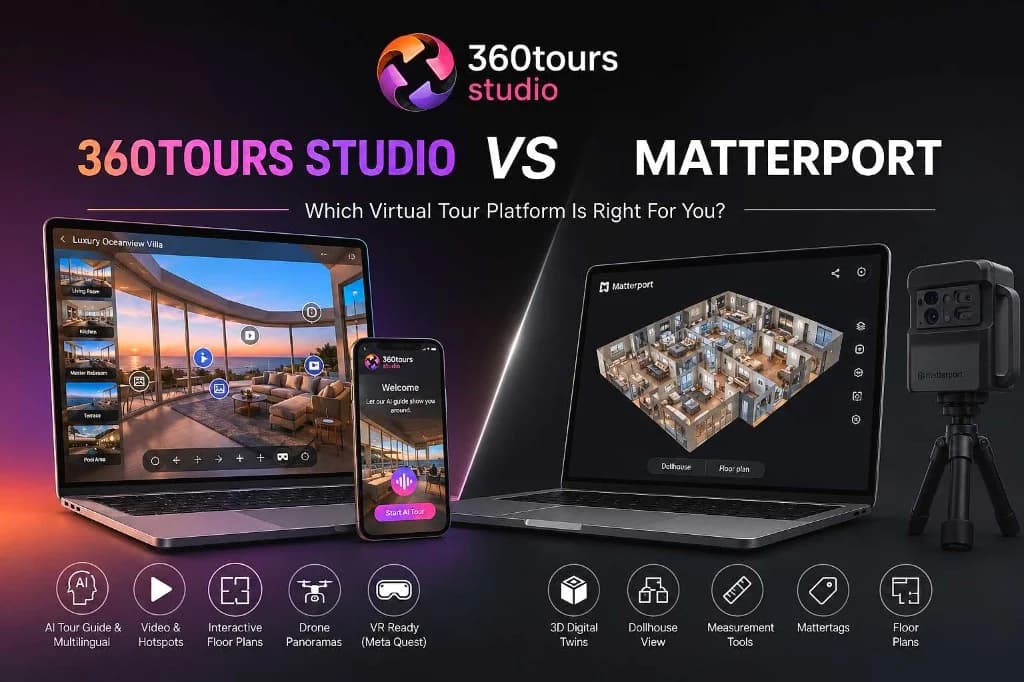
360Tours Studio vs Matterport: Which Virtual Tour Platform Is Best?
Comparing 360Tours Studio and Matterport: digital twins vs interactive 360 experiences, image quality, AI features, branding, capture speed and which platform fits marketing, education, tourism and property.
Virtual Reality and the Future of Immersive Experiences
Meta Quest, Apple Vision Pro and mixed reality are turning virtual tours into places you can stand inside. What VR changes for property, tourism and education — and what is coming next.
The Ultimate Guide to Virtual Tours (2026)
Everything you need to know about virtual tours: what they are, how they work, the technology behind them, the industries using them, and where AI and VR are taking immersive experiences next.